On October 30, Zara Shahjahan presented The Lotus Court. It wasn’t at a fashion week. It was a solo bridal show, staged in the courtyard of the Sir Ganga Ram Residence in Lahore. The name was literal. Models walked a curved white path around a pond of lily pads. Mist drifted over the water. A peacock sat in the branches overhead. But this wasn’t a show about prettiness. It was about memory, and about what Pakistan’s designers owe the generations after them.
"WE OWE THE FUTURE THE SAME"
Zara began the collection about a year ago, after a conversation with the creative people around her. Her concern was simple. South Asian designers borrow from the region’s historical craftsmanship all the time. Very few build on it.
“Every time in South Asia when we are designing, we take so much reference from the historical craftsmanship that exists,” she says. In the era of AI and ChatGPT, she adds, “I felt that we are really not leaving any references behind for the future generations.”
The pressure to keep producing new designs leaves little room for anything else. Designers reference. They don’t develop. “We’re not developing it and taking it to another level where this can also be taken as the history of South Asian craftsmanship,” she says. “I think we owe the future the same.”
It’s a fitting argument from her. She trained in miniature painting at Lahore’s National College of Arts and has built her label since 2004 on vintage silhouettes and old-world femininity. Her bridal line, launched in 2016, has always looked back. The Lotus Court looks forward too. It’s meant to add to the archive, not just draw from it.
THE SETTING
The venue mattered. Sir Ganga Ram, the engineer often called the father of modern Lahore, built many of the institutions the city still uses. A show about leaving something behind was staged at his home.
Set designer Hashim Ali turned the courtyard into a garden. A curved white runway wrapped around a dark pond planted with lily pads, reeds and tropical leaves. At its centre, a scalloped stone fountain opened like a flower. The brick facade of the residence, with its columns and tall wooden doors, framed the stage. Guests sat low along clipped hedges, close to the water. Every seat held a single red rose.
The rose returned in the installation space. A tree was wrapped from trunk to branch in strands of deep red flowers, with more strands falling from above like curtains. White plinths held small brass lamps and candles. An embroidered ivory kurta hung from a bamboo pole like a relic, with one rose laid beneath it. It felt less like a pre-show lounge and more like a museum. That was the point.
THREE ACTS: WHITE, PINK AND COLOR
The show unfolded in three segments.
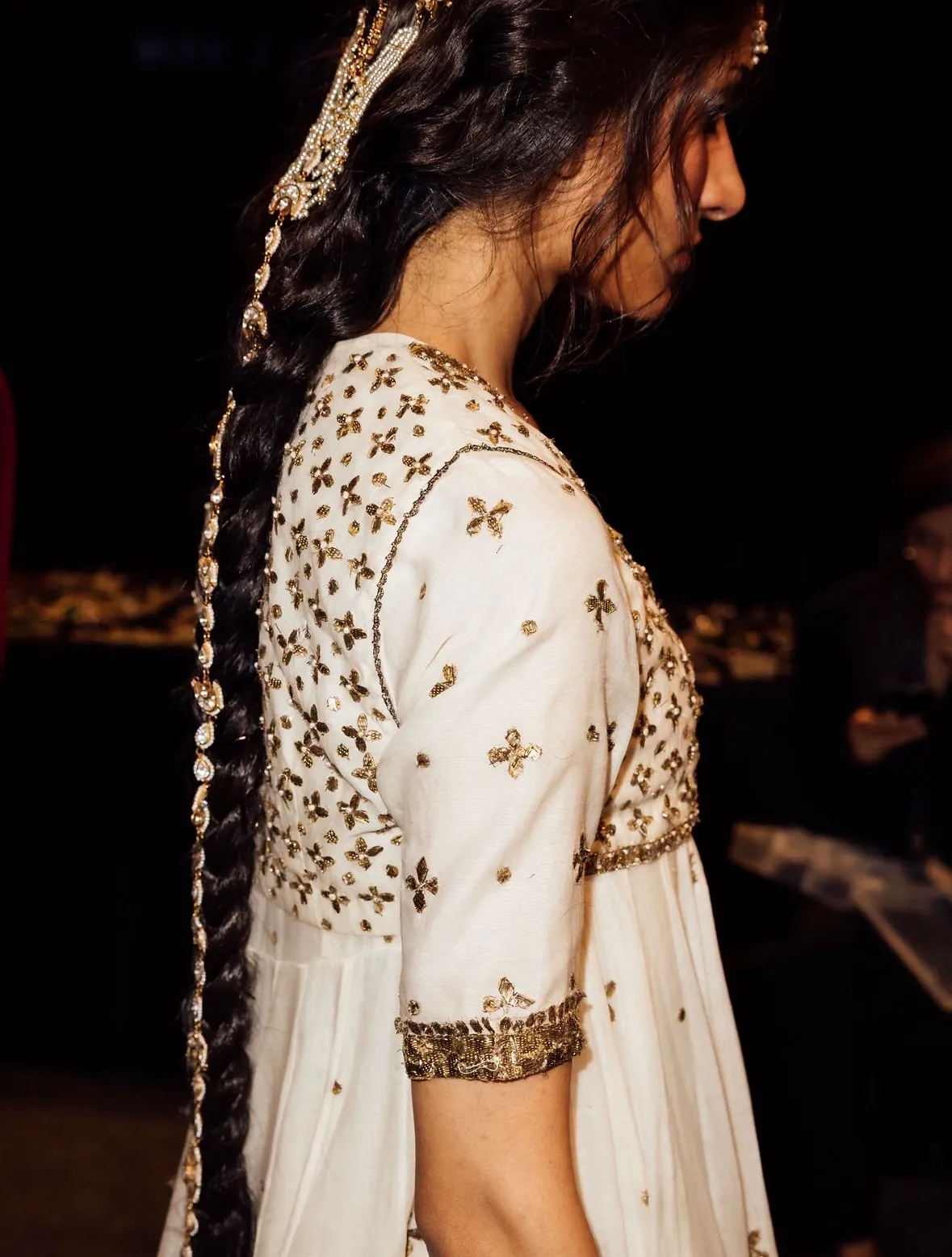
It opened in white. Barefoot models in sheer veils moved through the mist in ivory organza. One look stacked a tiered peshwas over a floor-length skirt, its hem worked in tonal florals, with a layered kundan choker. Others were scattered with small four-petal gota flowers or edged in white threadwork.
The second segment turned pink. Rose-toned kurtas under long jackets. Soft shalwar suits. Dupattas sprigged in gold.
Then came colour. A red anarkali covered in gold zardozi, its hem lined with arches. A red silk lehenga with a peplum choli embroidered in peacocks, worn with an olive dupatta and stacks of red glass bangles. A chartreuse brocade lehenga under a mustard choli. A rust anarkali. A fuchsia dupatta over an aubergine gharara. A blush and lilac gharara woven with roses. An antique-gold tissue kurta over crimson.
The colour story ran from restraint to celebration, the way a wedding does.
THE CRAFT
If the collection has a hero, it’s chatta patti.
The technique layers small cut pieces of fabric into patterns, each outlined in gota. Here it filled the deep flounces of lehengas and ghararas: olive and ochre beneath the chartreuse brocade, purple and lilac stripes on the aubergine gharara. A traditional technique, set in bold, graphic new arrangements. It’s exactly what Zara means by developing craft instead of repeating it.
The rest of the vocabulary went just as deep. Gota-patti flowers. Zardozi and dabka. Brocade and jamawar-style weaves. Sitara coins scattered across net dupattas. Threadwork on organza. Leaf appliqué rising from the hem of an ivory lehenga like reeds at the water’s edge.
Together, the pieces worked as a survey of South Asian handwork. Each one is a new entry in the archive she wants to build.
STYLING, HAIR AND MAKEUP
Stylist Yasser Dar kept every look rooted in the past without tipping into costume. The jewellery was heavy and traditional: nath chains running to the ear, jhoomars, matha pattis, jhumkas, layered chokers and rani haars, armbands, stacked bangles. Feet were bare or in gold juttis.
Hair and makeup by The Backstage Team, led by Sunil Nawab, took its cues from old cinema. Kohl-rimmed eyes. Full brows. Berry and red lips. Hair was slicked into centre partings, set in finger waves, or worn in long parandi braids threaded with pearl and kundan. One braid ended in a cluster of gold bangles.
Show director Umar Nadeem staged it like a period film, one scene at a time.
TESTIMONIALS FROM THE FRONT ROW
"What I admire about Zara Shahjahan’s design language is its familiarity. There’s a certain softness and nostalgia to her work, yet it never feels disconnected from the modern woman. The collection beautifully brought together traditional craftsmanship, thoughtful detailing and silhouettes that felt both romantic and timeless. I loved how the Lotus Court theme translated into the overall presentation, with the setting adding to the old-world charm of the showcase. For me, what makes bridal fashion truly special is its ability to preserve tradition while still feeling relevant to the woman wearing it today. It was a lovely reminder that trends may come and go, but craftsmanship, heritage and timeless design will always hold their place." — Sana Anver, celebrity stylist.
"It was truly lovely being part of the Lotus Courtyard showcase. I personally loved the entire atmosphere, from the set design and ambience to the overall vibe. Everything was put together so beautifully, creating such an immersive experience. I particularly loved how the showcase unfolded through its three segments. The whites were absolutely magical, the shade of pink in the second segment was just beautiful and the colour play in the third was so interesting and refreshing. Each segment had its own identity while still feeling connected to the overall vision. The collection beautifully celebrated craftsmanship, colour and Zara Shahjahan’s signature aesthetic. Overall, it was such a visually captivating experience, and I loved how seamlessly everything came together." — Momina Kashif, fashion designer.
WHY IT MATTERS BEYOND PAKISTAN
Global luxury leans on South Asian hands. Much of the embroidery seen on international runways is made in this region, and the people behind it are rarely named. The craft travels. The credit often doesn’t.
The Lotus Court pushes back on that. It presents Pakistani handwork as authorship, not supply: developed, documented and signed. That’s how a craft becomes heritage, and how a country becomes a reference point rather than a resource.
The format speaks the same global language. A single-designer show, a heritage venue, a set built around one idea. It’s the couture playbook, told in a Lahore courtyard.
Her question about AI isn’t a local one, either. Designers everywhere are asking what happens to originality when references are endless and instant. Zara’s answer is to slow down, go deeper and make something worth referencing. It places a Pakistani designer at the centre of a global conversation.
We owe the future the same, she says. With The Lotus Court, she has started paying.
CREDITS
• Designer: Zara Shahjahan (@zarashahjahan)
• Venue: Sir Ganga Ram Residence, Lahore
• Styling: Yasser Dar (@yasserdarrr)
• Hair and makeup: The Backstage Team (@thebackstageteam) by Sunil Nawab (@sunil_nawab)
• Set design: Hashim Ali (@hashimali90)
• Show direction: Umar Nadeem (@umar.nadeeem)
• PR: Fizza Ayaz (@fizzaayaz_)
• Photography: Abdullah Hamid (@abdulllahhamid_), Moeez Ali (@moeez), Aleena Naqvi (@snaqvi)