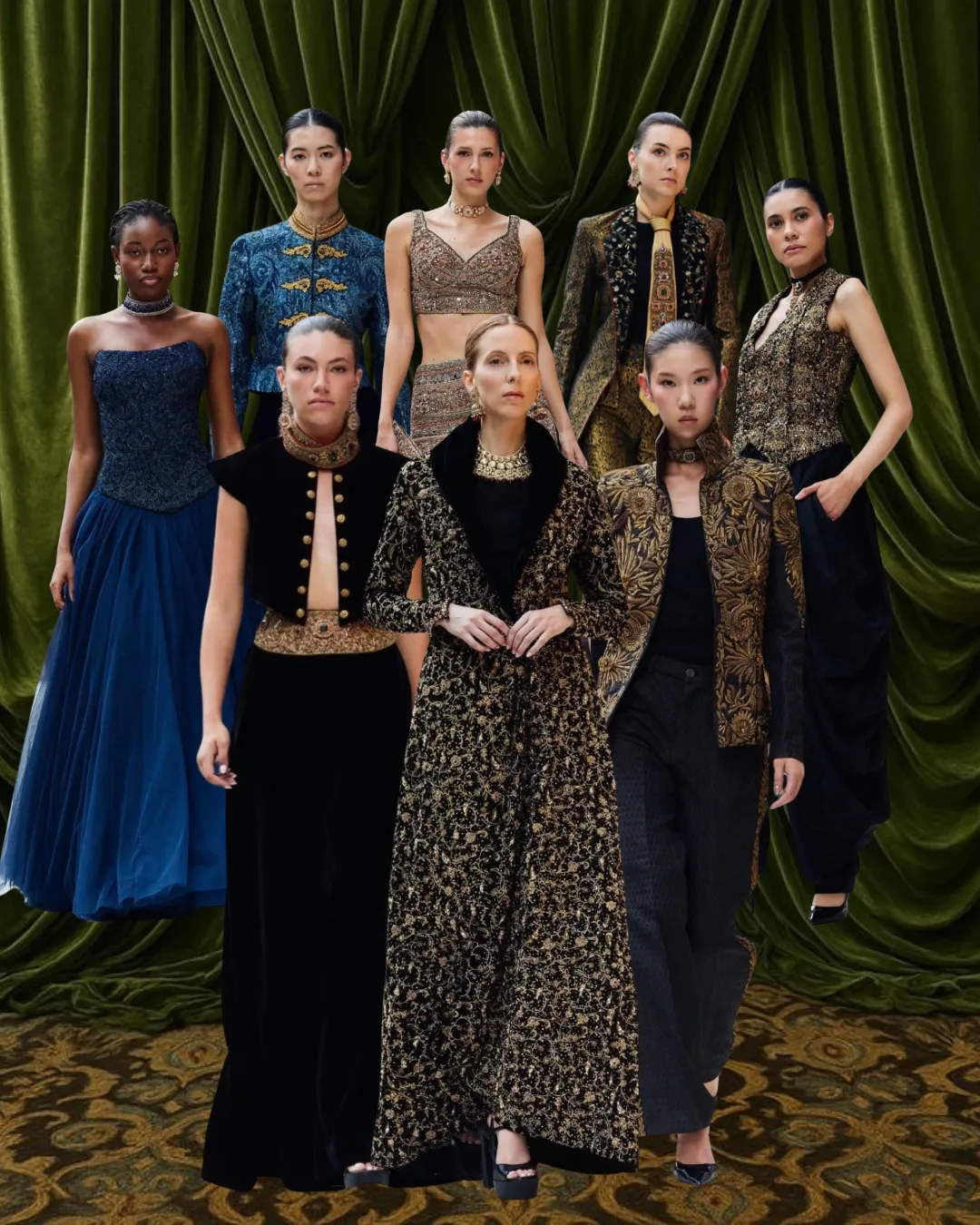
Parishae Adnan closed Flying Solo’s show at New York Fashion Week with Second Skin on September 13th. Eight looks. Every one was built from a garment that already existed.Flying Solo is an independent platform that runs during NYFW. The September show was held at 22 Vanderbilt Rooftop. Organisers count 620 outfits, six show times and designers from 34 countries. Parishae’s label was the one chosen to end it.
Her path to that rooftop was not a straight line. She worked in consulting, business, hospitality and management before fashion. She also worked in hospital care during COVID. She has said the career was never handed to her. She came back to fashion by choice, and the work shows it.
A collection built from what already existed
Circular fashion is a buzzword at fashion week. For Parishae it is the method. She says sustainability doesn’t have to mean giving up fantasy, craft or couture. Second Skin is her proof.
A bridal lehenga from around 2008 became a sculpted bustier and miniskirt. Suede from an unsold sherwani became a cropped jacket and wide trousers. A menswear waistcoat was rebuilt around a woman’s body. A pishwas became a floor-length coat.
THE LOOKS:
Look one, “My Father’s Tie,” sets the terms. A green-and-gold brocade suit is cut into an exaggerated hourglass. A gold raw-silk tie, hand-embroidered in 2001, sits at its centre. Tailoring built for men is reshaped for a woman, and nothing about it feels borrowed.
Look four, “Exoskeleton,” is the one to study. It began as an embroidered waistcoat shown in December 2024. Parishae pushed its pleats and darts outward. Construction that normally hides inside a garment became the surface. It is a designer showing her technique, not just her taste.
The order of the show is just as deliberate. It opens with sharp tailoring, strong shoulders and a tie. It moves into corsetry and exposed structure. It reaches full volume at look seven, a tulle ballgown. Then it ends with “Reincarnation.”
That last look says the most. It began as a 2024 pishwas. The original shape is gone, but the hand-embroidered black velvet carries into a new coat. Handwork, in her view, should outlive the garment it was made for.
The effort is real. The collection’s press materials say individual looks took upwards of 2,500 hours. A reviewer from Toronto’s Between the Covers named her his standout of the showcase. He praised how clean the tailoring stayed under all the texture and beading. That balance is hard to get right.
Musician Arooj Aftab, artist Sufi and actor Anika Zulfikar were among those in attendance.
WHAT IT MEANS FOR PAKISTAN:
Parishae calls herself a Pakistani couturier, and she is specific about what that means. “Pakistani design does not have to look traditionally Pakistani in order to be Pakistani.”
She isn’t the only Pakistani designer who showed in New York that week. Omar Mansoor presented The Living Loom on September 10, built on handwoven khaddar from Kamalia. Two designers showed craft-led collections, and neither dressed it up as national costume.
That is the shift. Embroidery, textiles and handwork are the foundation of the design, not a theme added on top. International outlets reviewing Second Skin wrote about corsetry, construction and technique. That is how serious couture gets discussed.
One show doesn’t redraw the fashion map. But Parishae made a collection that asks to be judged on how it was made. She has also said she wants her work to keep changing form, and that she never wants the name Parishae to become predictable.